Abstract
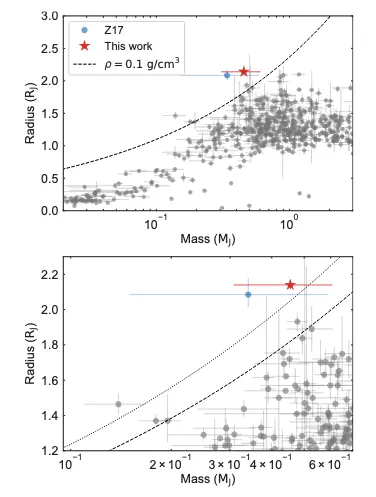
Low-density ($\rho < 0.1 \mathrm{~g} \mathrm{~cm}^{-3}$) hot Saturns are expected to quickly ($<100$~Myr) lose their atmospheres due to stellar irradiation, explaining their rarity. HAT-P-67~b seems to be an exception, with $\rho < 0.09 \mathrm{~g} \mathrm{~cm}^{-3}$ and maintaining its atmosphere to well after 1 Gyr. We present a photometric and spectroscopic follow-up of HAT-P-67~b to determine how it avoided mass loss. HAT-P-67~b orbits a $V=10.1$ evolved F-type star in a $4.81$ day orbit. We present new radial velocity observations of the system from the NEID spectrograph on the WIYN 3.5m Telescope from a follow-up campaign robust to stellar activity. We characterize the activity using photometry and activity indicators, revealing a stellar rotation period ($5.40\pm0.09~\mathrm{d}$) near HAT-P-67~b’s orbital period. We mitigate the stellar activity using a constrained quasi-periodic Gaussian process through a joint fit of archival ground-based photometry, TESS photometry, and our NEID observations, obtaining a planetary mass of $M_p = 0.45 \pm 0.15$~M\textsubscript{J}. Combined with a radius measurement of $R_p=2.140 \pm 0.025$~R\textsubscript{J}, this yields a density of $\rho_p = 0.061^{+0.020}_{-0.021} \mathrm{~g} \mathrm{~cm}^{-3}$, making HAT-P-67~b the second lowest-density hot giant known to date. We find the recent evolution of the host star caused mass loss for HAT-P-67~b to only recently occur. The planet will be tidally disrupted/engulfed in $\sim 150-500$~Myr, shortly after losing its atmosphere. With rapid atmospheric mass loss, a large, helium leading tail, and upcoming observations with the Hubble Space Telescope, HAT-P-67~b is an exceptional target for future studies, for which an updated mass measurement provides important context.

Le-Chris Wang
Graduate Student
My research interests include planet formation, demographics, exoplanet atmospheres, galactic archeology, and data mining in astronomy.